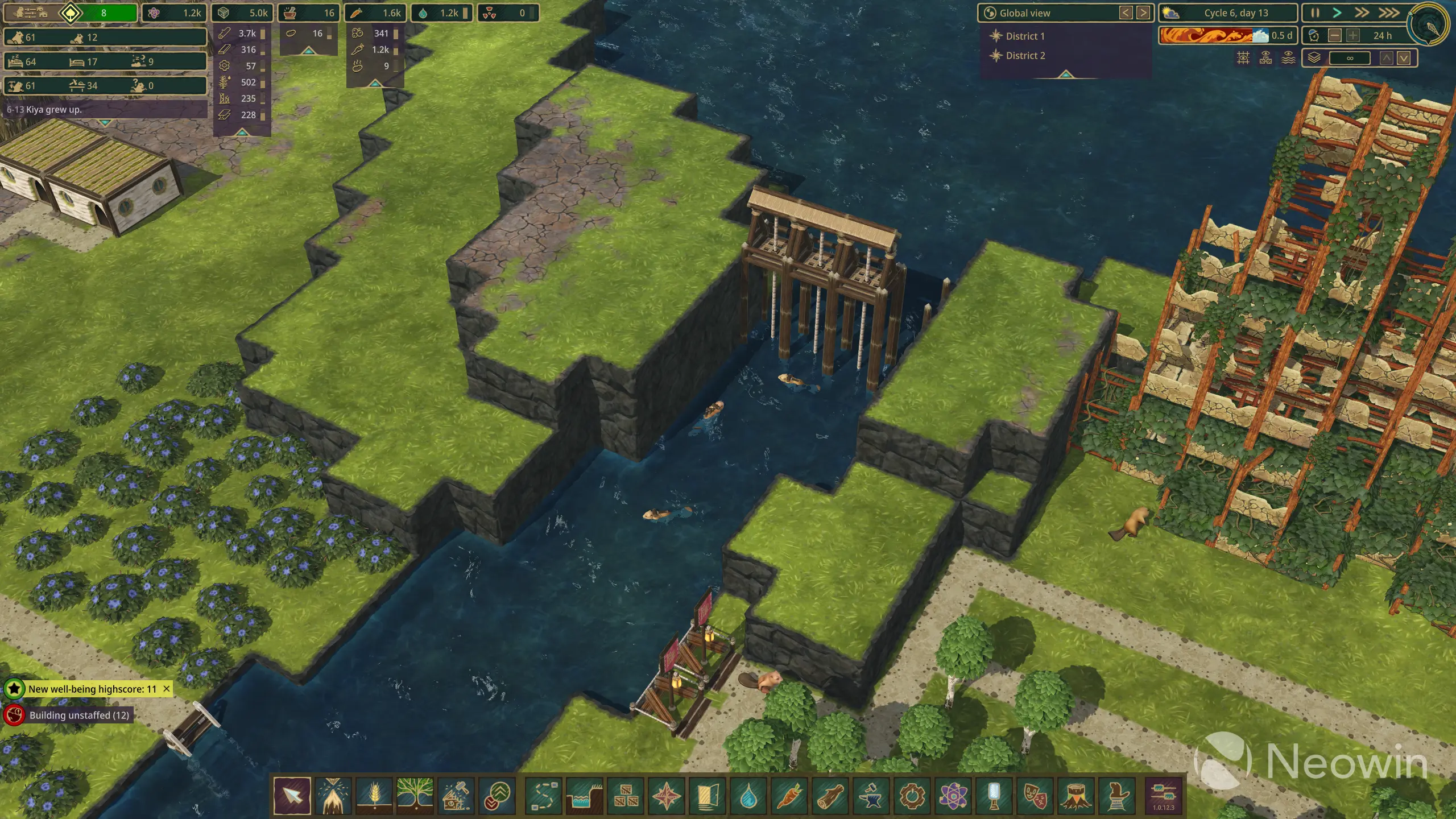
Beavers are not my first choice of species when selecting a successor to humans after the apocalypse hits, but that’s exactly what developer Mechanistry had chosen when making Timberborn. This isn’t a new game by any means. Timberborn first appeared as a Steam Early Access game back in 2021, and five years later, it finally reached version 1.0, declaring itself as feature complete. While Timberborn did catch my eye a few years back, I was in the dark about its gameplay and themes until I had the chance to review the release version a few weeks ago.
I am decently familiar with the colony simulation and city-building genres, which come in a variety of flavors ranging from medieval to sci-fi. Even compared to all that, Mechanistry’s unique Lumberpunk experience, where we build a, hopefully, thriving beaver society, instantly drew me in, despite its unlikely rough edges. Before long, I was playing deep into the night trying to plug holes in my dams and wishing for rain as the unforgiving weather turned my lush farmlands into barren wastelands.
The world has effectively ended, and all that’s left is a little bit of greenery, a hopeful colony of beavers, and droughts that are becoming longer and longer. There aren’t any other colonies to compete with, or any sort of combat involved here. It’s all about surviving this harsh landscape and making sure my beavers make it through the next rough patch, and that means they have to work their tiny paws off to build things a little more advanced than just dams too.
Wading in, I tried to assess the game as a fresh release instead of thinking about its years in early access. Below you’ll find my full review of Timberborn 1.0.
The Way of Water
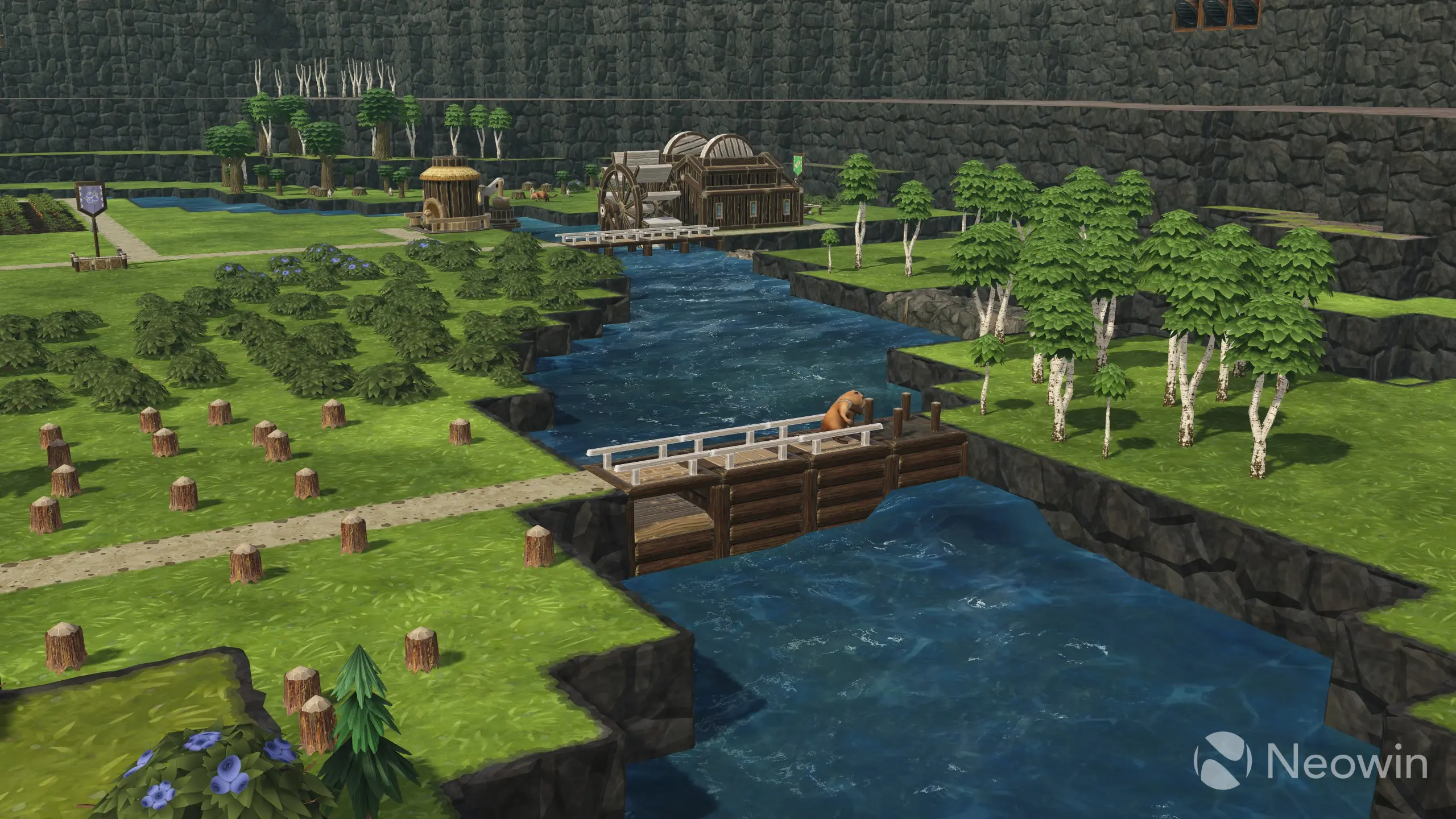
From the start, the water simulation system is the star of Timberborn. Without access to water, the land dries up, plants and trees die off, and eventually, the budding new civilization ends entirely. During the regular seasons, there’s more than enough water for everybody. The beavers can start farming, grow crops and trees on the irrigated land, and even pump and collect water into tanks for safekeeping.
On my first run with the game, I was happily expanding the tiny town of mine, expertly named BeaTopia by me, while wasting plenty of time being at the fastest simulation speed. Soon, a notification announces the coming of the first drought. To put it mildly, I was not prepared.
The river waters don’t slow down or settle somewhere. During droughts they just flow off the map like someone removed the stopper from a bathtub. This leaves behind barren land across most of the map except for a few ponds that might have deeper recesses in the earth to capture some of that earlier water. These begin evaporating fast too. Suffice to say, soon my meager crops died, and the one barrel of water that I happily collected stood drier than my beavers’ fur. I couldn’t stand to watch my colony die a slow death, so BeaTopia 2.0 was born, which is where I slowly learned how to bend the water to my will.
The water flow and accumulation tech of Timberborn is easy to understand and incredibly satisfying to take control of. It starts off simple with barrier blocks like levees and dams, but soon, technological advancements bring mechanisms like valves and floodgates for more complex control of fluids on maps, which can be manually adjusted or even automated.
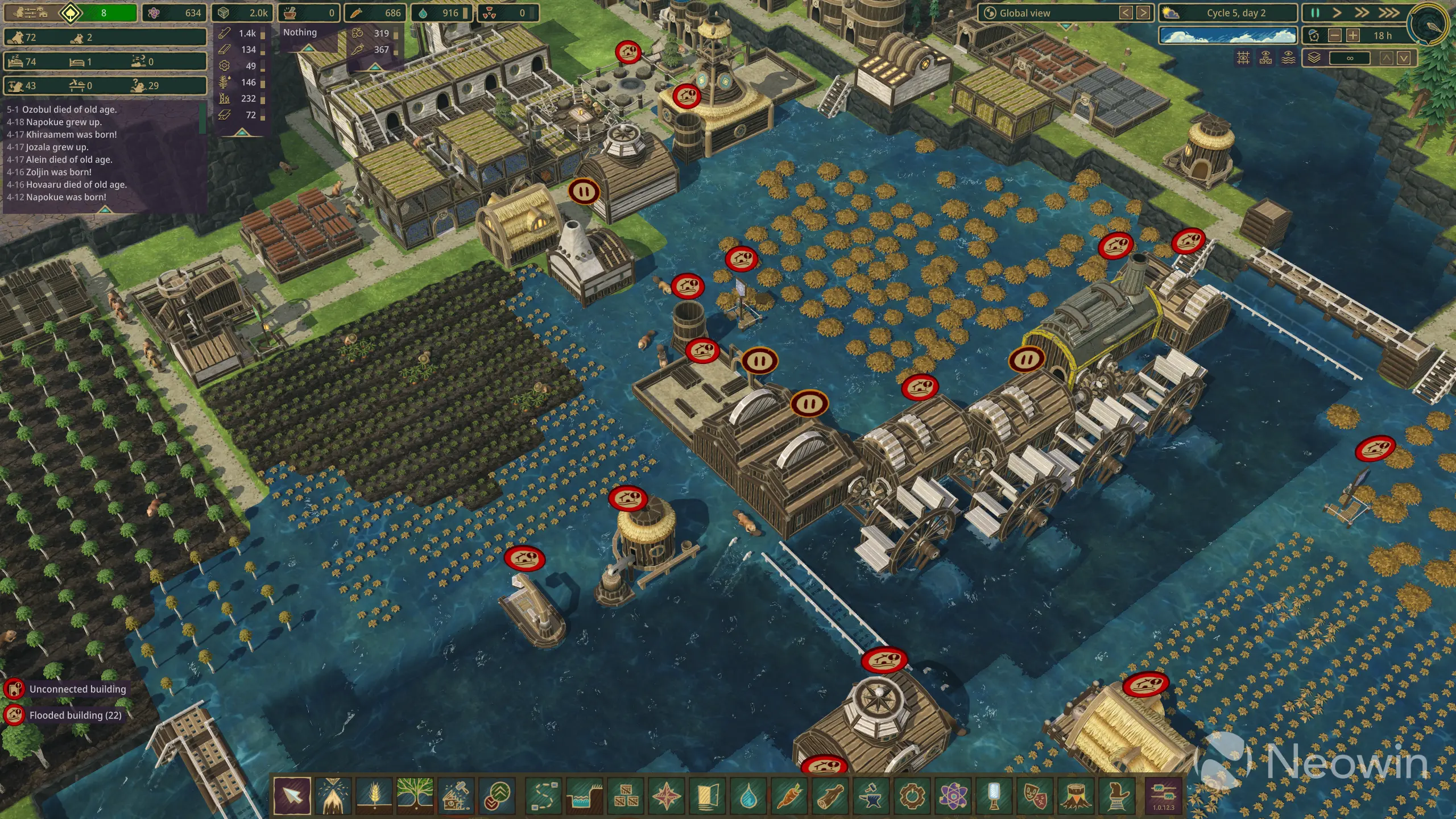
While it can take some time to accomplish, diverting a portion of a river to a modified area to hold and finally making it through a drought without all of it evaporating is an amazing feeling. These droughts get longer and longer as the game goes by, so there’s always a challenge to transform the land to retain as much water as possible before the next one hits.
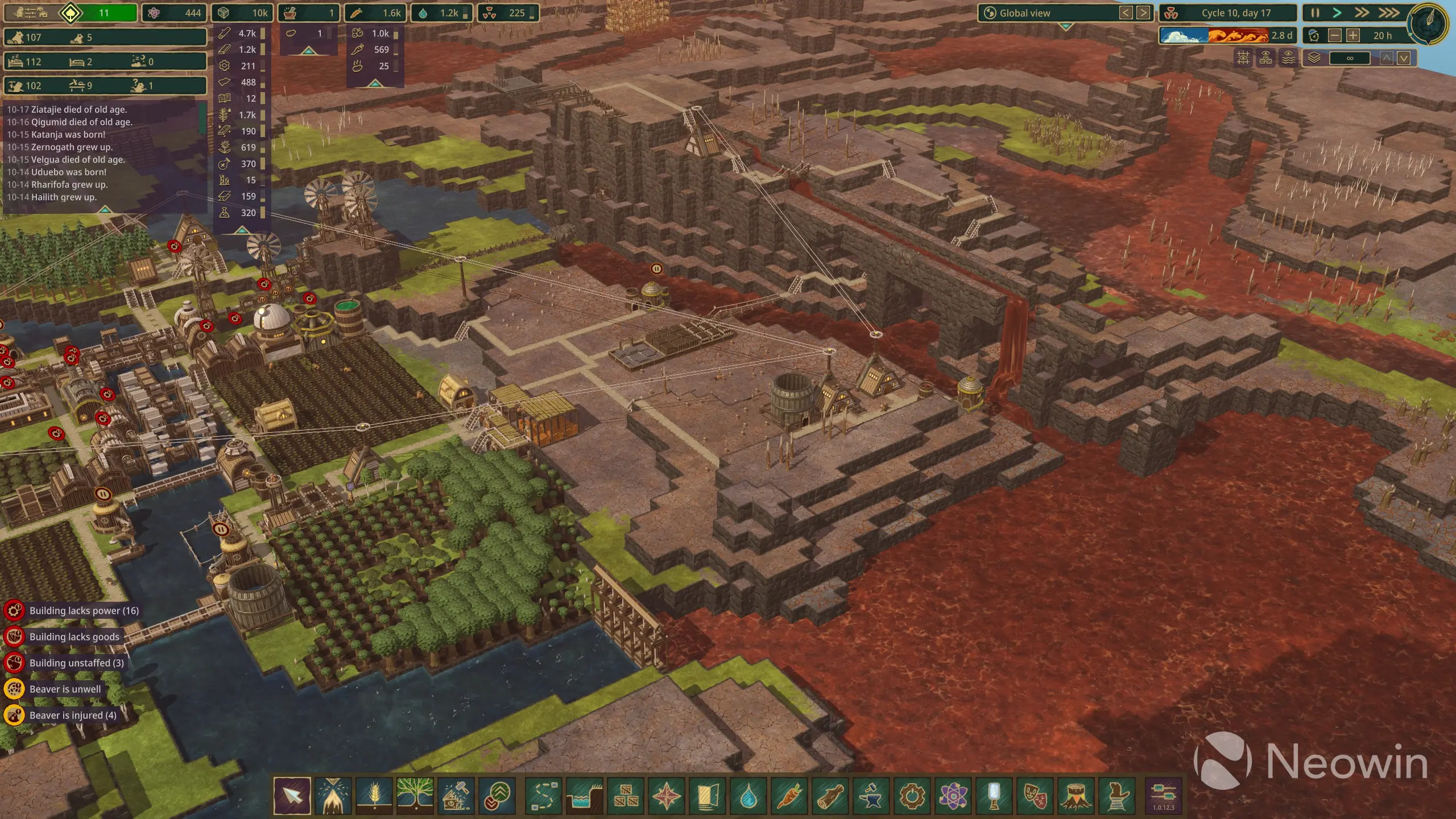
In the mid-game, right around the time that things seem stable and I feel like I am mastering the drought issue, Bad Water begins its movement as a dangerous new weather event. Instead of the map’s water running out, at times it can be fully replaced by contaminated tides that can quickly poison and kill plants, trees, and beavers with no hesitation. It felt unfair at first, seeing all my hard work of storing water backfire as the reservoirs fill up with poison, but it’s a feature that made me think even more about my city layouts, water flow routes, and how exactly I can deal with these natural disasters.
Building separate canals or entire sealed channels for rerouting the toxic waste around and away from my precious lands was the next hurdle. The Bad Water itself is a useful resource for some buildings and technological advancements too, so it’s another factor to consider before diverting it all away.
Essentially, I am giving my beavers an artificial drought so those original water storage plans can be reused. It’s a system that rewards creativity and forward thinking, but depending on the chosen difficulty, even small mistakes can be deadly for the whole colony
Lumberpunk
Construction is another high point of Timberborn. Other than offering a satisfying number of tools for controlling water flow and storage, beaver buildings themselves can be creatively planned to take up the least space possible while housing the most population and still offering amenities. Irrigated lands are valuable, and the only way to save more of it is to build up, not wide. It’s like a puzzle by itself to find more ways of keeping things packed and still being efficient.
The beavers themselves have their own needs and wants. Other than the simple joys of having different types of food, these critters love having a social life, beautiful monuments on their way to work, fun activities to do in their off-time, and even reading books. The better I can provide for them, the faster they work and the longer they live. While having more beavers to do more work sounds like a good plan, each additional beaver that’s born is a strain on the food, water, and housing systems. I had my city overpopulated under the strain a few times, which was harder to fix and come back from compared to being underpopulated. It’s all a balance.
Adding to all of that, there are currently two beaver races to choose from when starting a map. Each comes with drastically different play styles, where one focuses on building with nature and natural breeding, while the other relies deeply on industry and cloning. It’s a massive boost to map replayability.
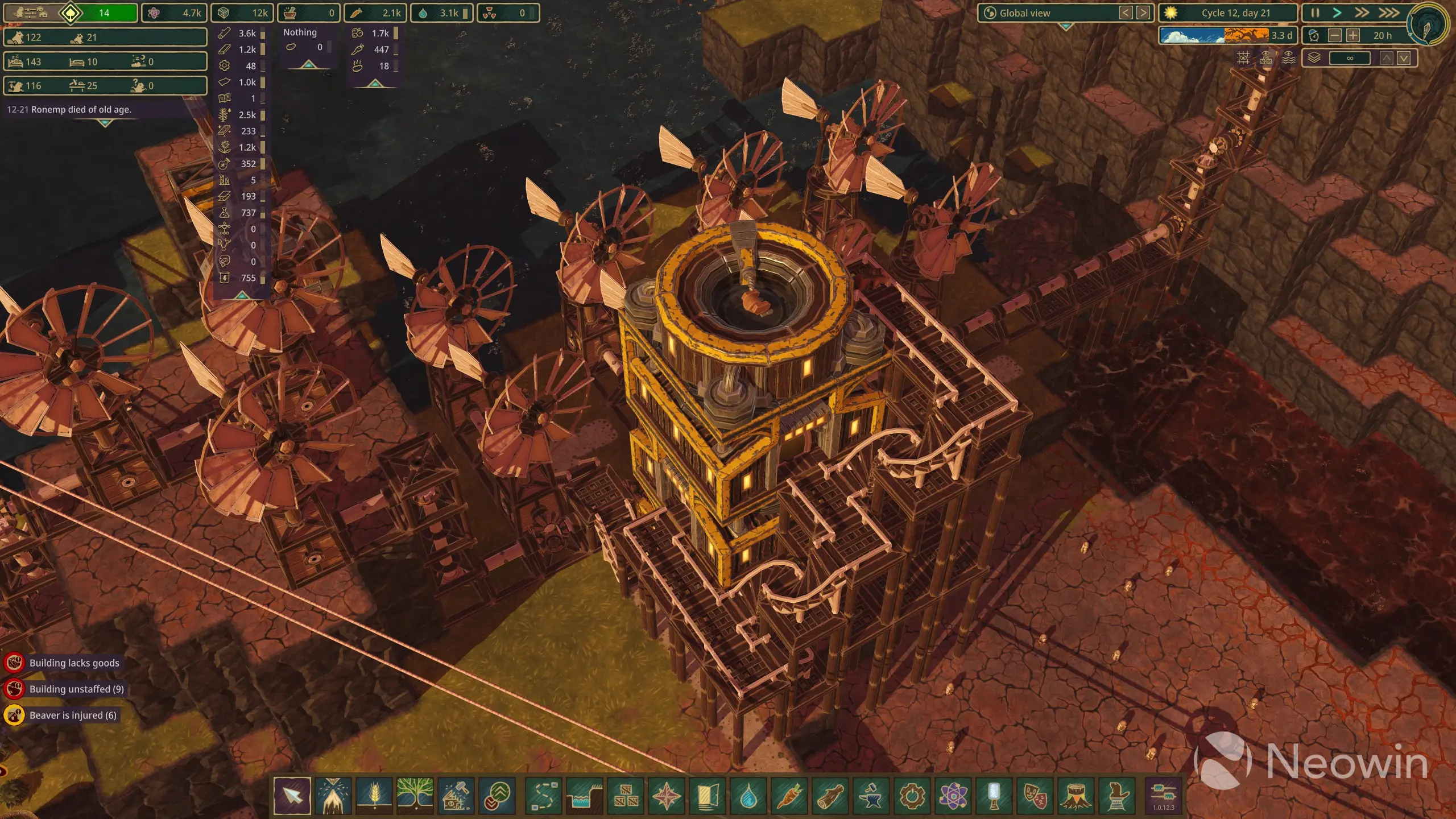
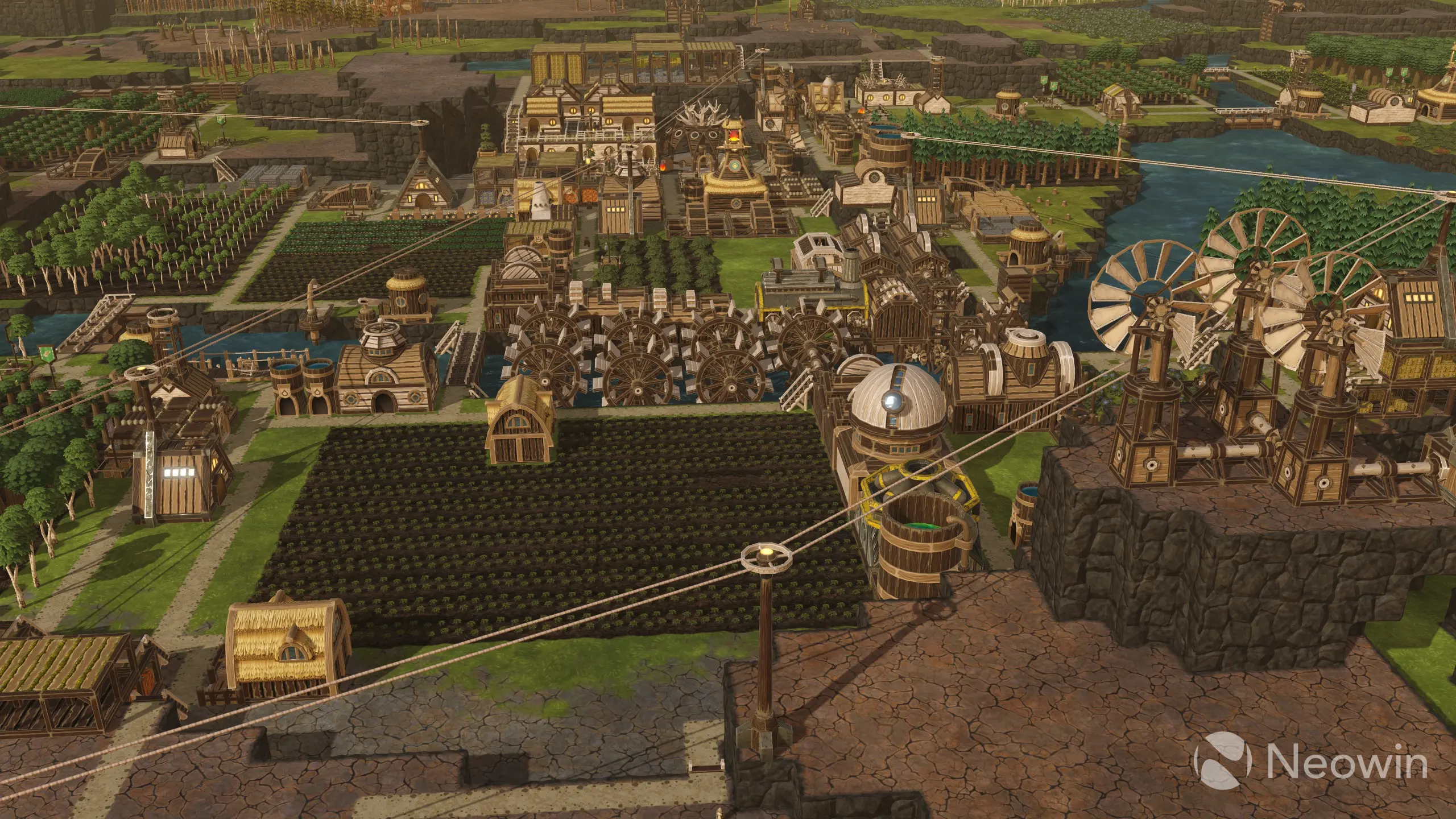
Throughout a playthrough, the colony beaver advances through simple technologies like water wheels, all the way to centrifuges and mechanized beavers, somehow all made of wood of course. Every step usually involves planting a different kind of crop or building towards faraway resources, like scrap metal from ancient human structures.
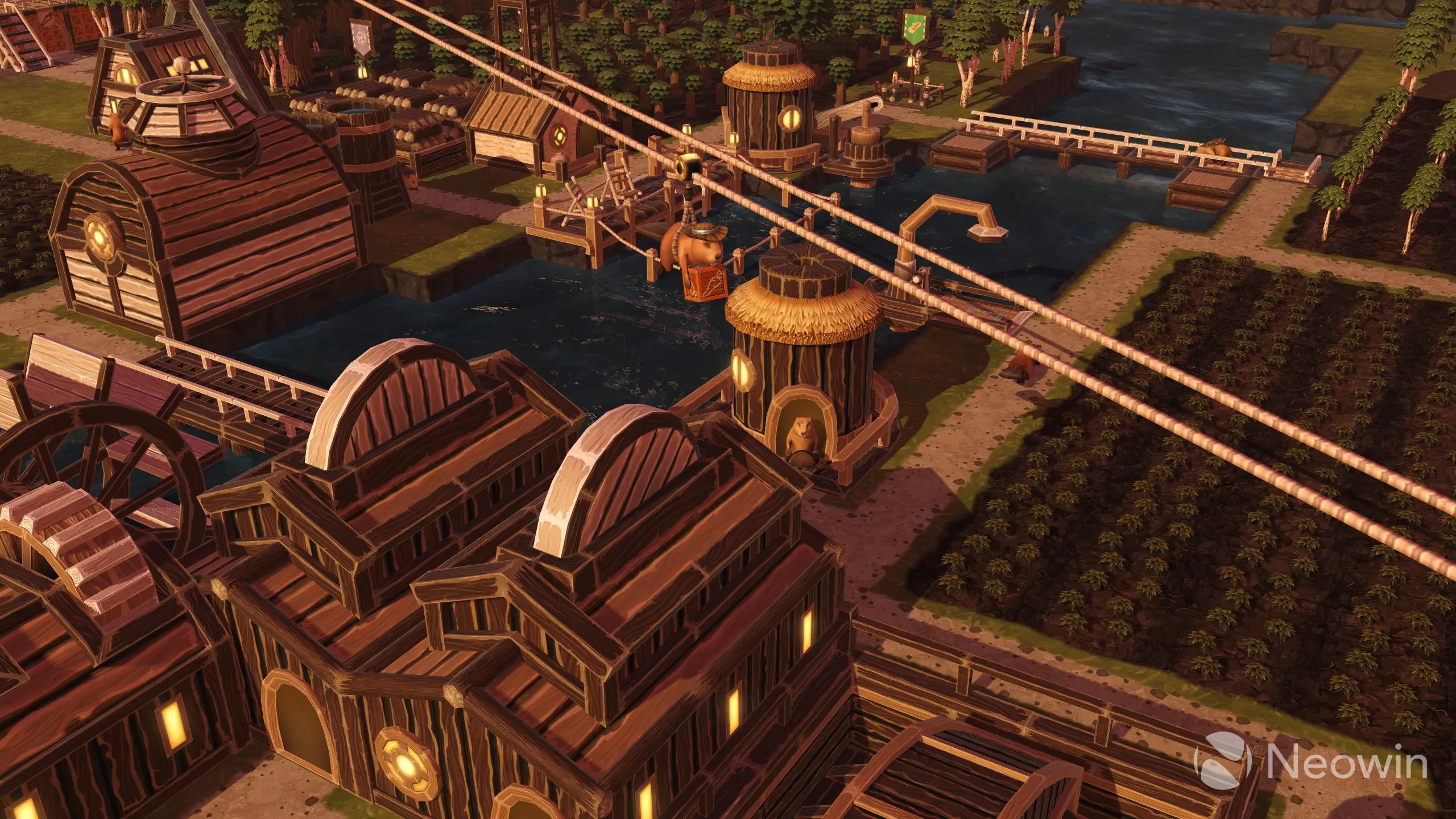
At first, I was building multiple floors of housing to save space and make a downtown area for my beavers to sleep in before dispersing in the daytime (if I decide to not give them overtime). Then came the metal platforms that can hang over structures and the ziplines to get everyone around as fast as possible.
The 1.0 release has a whole bunch of maps with a large variety of terrain formations, and the built-in map editor offers almost unlimited customization. Even the biggest maps are small in comparison to major city-building games. Oddly enough, this was never a downside thanks to all the vertical building opportunities and puzzle-like terraforming that’s required to survive. I would even add that the larger maps can get boring because of just how much space there is to exploit, making them less challenging endeavors.
Missing instructions
For a game that has been in early access for half a decade, the tutorial of Timberborn is glaringly lackluster. It consists of boxes that pop up on the corner of the screen with a couple of sentences on controlling the camera and how the early game works. Unfortunately, it’s more like a barebones hint system than an actual tutorial, lacking much needed details about many of the game’s water control systems, buildings, and automation. There is also no way to get the hints back after they go away unless you restart a map.
The developer sent documents full of information about the physics sandbox, gameplay, and advanced building tips as a part of the review package. I don’t see why this isn’t a part of the game, perhaps made available as an in-game wiki instead of having to resort to community resources online. I avoided the documents largely to see just how I can manage on my own. My prior experience with colony-building and resource management games helped immensely here. If a casual player picks up Timberborn after seeing it on Steam and thinking it’s a cute and simple beaver-powered city-building game, I don’t imagine them lasting that long before giving up. Of course, there are plenty of online tutorials and dam-building guides, but many of these cover older early access versions of the game before major reworks or feature additions, adding another layer of complexity.
I would have loved to see a mini-campaign that serves as an effective tutorial, guiding players through the major systems and how water physics interacts with the world.
Districts are another area that feels underbaked. They are city hubs that can house new bands of beavers with their own needs and working areas, built separate from the main colony. This sounds good on paper for reducing travel times for far away, major projects or perhaps building multiple cities on a single map.
However, setting up housing, water, farming systems, and the same amenities a second or third time from scratch, which is a requirement, turned out to be a chore. I simply resorted to using longer paths, which have unlimited reach, for my beavers to reach far projects and switched to using ziplines during the mid-game for even better optimization. The game’s use of smaller-scale maps further shows the ineffectiveness of the district system, conflicting with the game’s design.
Conclusion
Mechanistry has something special here. Everything from the intricate water diverting and collecting systems to the resource management gameplay is dangerously addictive in Timberborn. It has that “just a bit more“ feeling nailed down, which I have fallen victim to more than a few times while writing this review. I would start one project and realize it needs something else fixed first, which requires another thing to be unlocked and built on the other side of the map. Six hours later, my original problem I forgot about rears its ugly head and floods my entire city. I’m glad the beavers love to swim at least.
Starting a new map and figuring out what exactly needs to happen to survive droughts and poisoned water tides is somehow very satisfying, even before starting any construction. Timberborn’s maps are like a puzzle box that can be adjusted and transformed into anything given enough time and patience. Let’s not forget about the huge amount of replayability thanks to the two beaver factions available to play with either.
While this colony-building and management game gets a big recommendation from me, it’s not the best start for anyone jumping into these kinds of genres for the first time. If you’re new to the genre, the barebones tutorial is a big minus unless you don’t mind scouring through community resources about mechanics and items. The Districts feature seems underbaked at the moment as well. It was the only system that felt boring to implement into my cities. These aren’t dealbreakers, but they are frustrating nonetheless for such a well-polished game. As Timberborn reaches version 1.0, I am hoping Mechanistry plans to continue updates going forward and keep these beavers busy.
Timberborn is available on Windows and macOS for $34.99 on Steam.
This review was conducted on a pre-release 1.0 version of the game provided by Mechanistry.
Pros
Beavers and Lumberpunk themes
Water physics and season systems
Addicting resource management
Dense, puzzle-like maps
Replayability
Cons
Glaringly barebones tutorial
No in-game wiki or resource page for mechanics
Districts seem underbaked